 

 The U.S. Semiquin­centennial 

Celebrating 250 Years of the United States of America

July 4, 1776—the day the Declaration of Independence was officially signed, proclaiming the United States as its own nation. Now, in 2026, the United States is celebrating 250 years of independence! Britannica Education’s experts have brought together this hub of resources, activities, and interactive media to help spark curiosity, foster critical thinking, and provide a jumping-off point for students to look back at the United States’ beginnings.


a boy holding an american flag


 How to Pronounce Semiquin­centennial ?

Say it with us! Semi…quin...centennial.


BE_Thistle-Variation-4


 Featured Lesson Plans & Activities 

By diving into history—whether recent or long ago—students gain a deeper understanding of the present, learn from past decisions, and develop critical-thinking skills. Plus, history is simply fascinating! These ready-to-use tools will help spark meaningful discussions, inspire curiosity, and jump-start research.

Statue of George Washington on a horse

Meeting George Washington Lesson Mini
(Grades K-2)

Teach about George Washington’s life, his role as first president, and more using age-appropriate informational text.


composite image of multicolor hexagons

Hexagonal Clusters
Strategy
(Grades K-12)

Support making connections among people, events, and themes, mirroring the complexity of historical causation and context.

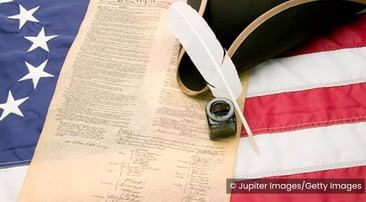
composite image of the United States constitution over an American flag with a feather pen and ink

Creating a New Nation Lesson Mini
(Grades 3-5)

Introduce civics and citizenship by digging in to the Declaration of Independence, the U.S. Constitution, and the Bill of Rights.


Boy studying looking at a book

Understanding Sources Lesson Mini
(Grades 6-8)

Emphasize key research skills to evaluate sources, such as the Declaration of Independence or the Bill of Rights.


Person studying using a laptop

Primary and Secondary Sources Academic Toolkit
(Grades 3-5)

Provide guidance on understanding and utilizing primary sources, such as the Declaration of Independence, in collegiate research.


Magnifying glasses over a blue background

Evaluating Evidence Strategy
(Grades 6-12)

Reinforce the core skill of analyzing and corroborating sources to build a historical argument.

image of several lines converging into one

Build a Summary Strategy
(Grades K-12)

Cultivate skills for synthesizing large volumes of research into concise, focused statements—essential for projects and exhibits.


multicolored empty dialogue bubbles

Discussion Café Strategy
(Grades 6-12)

Promote dialogue-based analysis of different perspectives, modeling how historians debate and interpret evidence.


composite image of a hand holding a question mark

Question It! Strategy
(Grades 6-12)

Deepen comprehension through discussion and collaboration that invites students to generate their own questions about a text.


Britannica flower icon.

Spotlight Resources

Looking for ready-to-use tools to spark student discussion? Use these curated resources to highlight historical events like the United States’ 250th anniversary.

statue of Paul Revere on a horse

National History Day®

Did you know that every June, National History Day® (NHD) hosts an international contest? Middle and high schoolers get to conduct and present historical research on a topic of their choice. This year’s theme? Revolution, Reaction, Reform in History.

 

How a Historical Interpreter Connects to the Past at Colonial Williamsburg

Historical interpreter Stephen Seals discusses how he educates the public about the history of slavery at colonial Williamsburg.

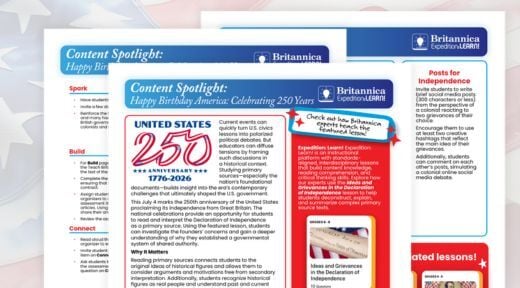
us-usa-250-content-spotlight

Happy Birthday, America!

Learn how to use Britannica’s interactive Expedition: Learn! Ideas and Grievances in the Declaration of Independence lesson to explore primary sources in America’s history.


the united states capitol building with american flags in front

Meet the Presidents & Government Branches

In this download, students learn about the three branches of the U.S. government and get fun facts about the 45 men who have served as our nation’s 47 presidents. (One could dance a jig, one carried his work in his hat, and one was not elected!) 

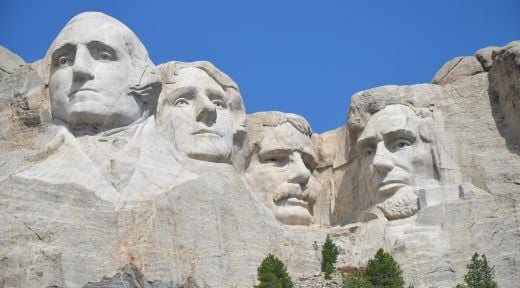
Mount Rushmore: faces of presidents George Washington, Thomas Jefferson, Theodore Roosevelt, and Abraham Lincoln carved into the side of a mountainCommanders-in-Teach

Teach about the presidents of the United States using this collection of activities, including Britannica School’s timeline feature, museum visits, and more.


 Video: Bill McKibben Talks Climate Change 

Environmentalist, journalist, and New York Times bestselling author Bill McKibben discusses the problem of climate change and what we can do about it.

Britannica-thisle-white-transparent-800-0126

 Join Our Newsletter 

From tips and tricks to engaging activities, find attention-grabbing content for tormorrow’s lesson.